Wall Art Guides · 4 min read
Dining Room Wall Art Placement When the Table Moves
Should art follow the sideboard, wall or table? Compare fixed centres with everyday and hosting layouts before choosing where to hang it.
Published
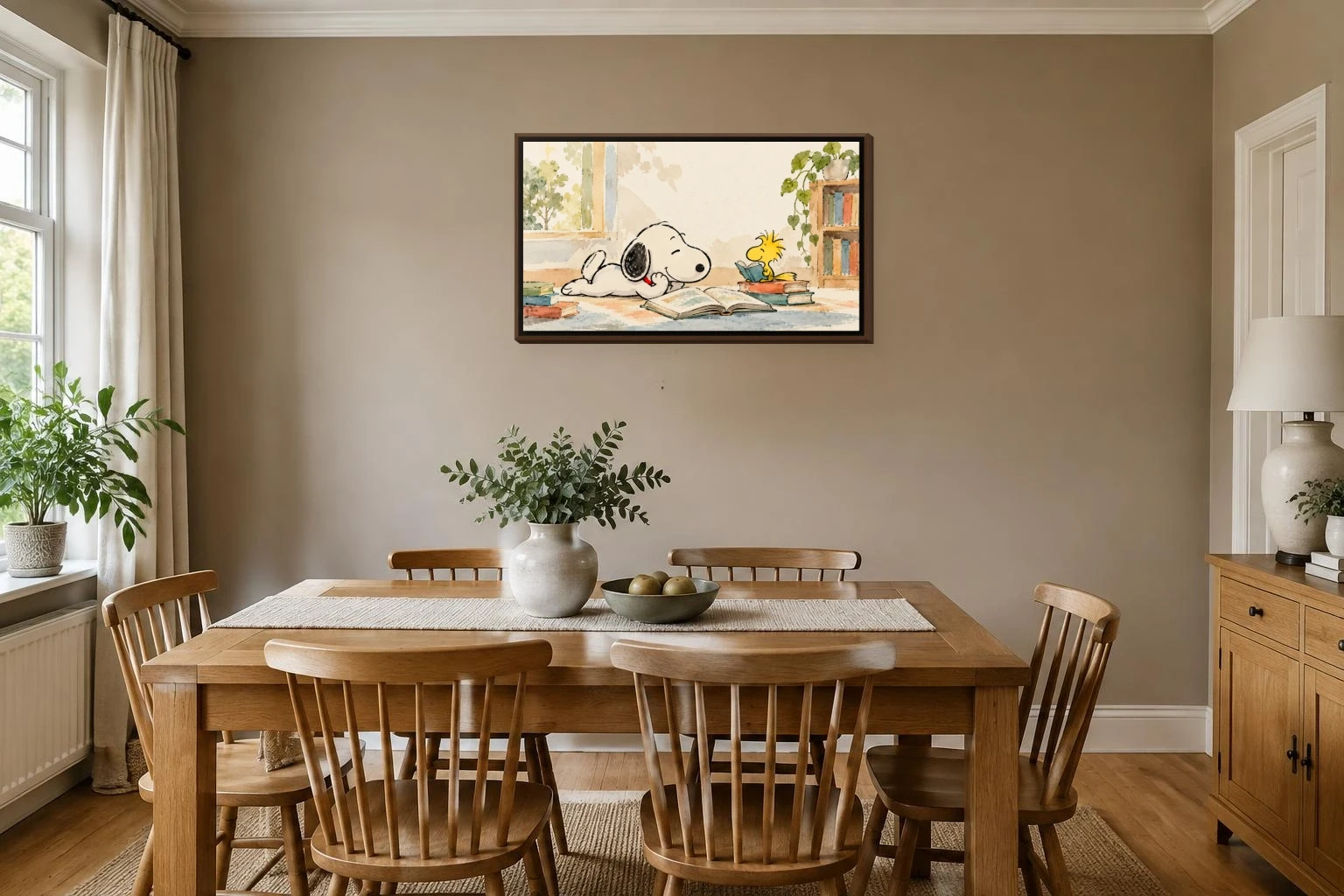
When planning dining room wall art placement, consider both everyday meals and the arrangement you use for guests. Rather than automatically centring the picture over the table or splitting the difference with a sideboard, test which relationship you want to preserve. These practical questions will help you compare positions before making fixing holes.
How do you identify the competing centres?
Choose a fixed corner as your starting point and measure along the artwork wall in centimetres. Label four possible centres: W for usable wall, S for sideboard, T for everyday table and H for hosting table. For W, use the clear stretch between boundaries such as a doorway and a corner.
Imagine looking down on the room, with the artwork wall across the top. For T and H, find the tabletop’s two outermost edges in the direction parallel to that wall. Using a suitable square or laser guide, project those edges straight towards the wall at right angles, then mark halfway between them. Avoid measuring diagonally from the corner.
Make a paper template using the artwork’s confirmed overall dimensions, including any frame. Mark its centre and attach it with temporary fixings suitable for your wall finish. Keep its size and height unchanged while comparing horizontal positions.
What if the table and sideboard do not line up?
Compare S with T first. For wall art above a sideboard, try S as your starting point: you may prefer the artwork and furniture beneath it to read as a pair. Then move the same template to T without rearranging the furniture.
From the doorway and dining chairs, compare the picture’s edges with the sideboard below. Does T make the picture look accidentally displaced, or does it connect the dining area more comfortably? Repeat with the hosting arrangement. Consider keeping S if that pairing feels settled in both layouts; do not assume an in-between position will resolve the mismatch.
What if there is no furniture beneath the picture?
Compare W with T, then check H. For art beside a dining table, try the usable wall midpoint before the table midpoint. Compare the empty space beside the template and its proximity to doors, switches and corners.
Consider W if you want the picture to feel independent of furniture movements, or T if everyday dining is your priority. When the table projects into the room, avoid choosing picture width solely from its length towards you. Assess scale separately using How to Choose the Right Size Wall Art.
What changes when the table extends or moves?
Illustrative room measurements—not product dimensions: imagine a clear wall stretching from 0 to 360 cm, with W at 180 cm. Place an offset sideboard’s centre, S, at 100 cm. Imagine the everyday table parallel to the wall, with its projected ends at 40 and 200 cm: T sits halfway between them, at 120 cm.
Now imagine extending only the right-hand end by 60 cm, without moving the other end. The projected ends become 40 and 260 cm, so H is 150 cm. In this example, the candidate centres run from left to right as S at 100 cm, T at 120 cm, H at 150 cm and W at 180 cm.
For an equal extension at both ends without shifting the table, T and H coincide. Still test the extra chairs and usual centrepiece. If you move or rotate the table for guests, measure its projected centre again rather than reusing the extension example.
How can you compare the options without losing track?
Keep a short note for each candidate using the same labels: Centre and distance, Everyday appearance, Hosting appearance, and Main compromise. For example, you might write: “S, 100 cm; balanced over sideboard; still comfortable with guests; not centred on table.” Treat this as a recording format, not a recommended outcome.
Compare each position from the same doorway and occupied chairs in both configurations. Photographs taken from those viewpoints may help. Favour the arrangement you use most, provided the other remains comfortable; if none works, consider another wall rather than forcing all four centres to agree.
What should you check before making fixing holes?
Once you have chosen a horizontal centre, test height separately. Try a slightly lower template if it feels remote when seated, and check whether the pendant, chair backs, centrepiece or sideboard accessories interrupt the view. Move a tall accessory before rejecting an otherwise comfortable position.
Record the chosen centre’s distance from your reference corner, overall artwork dimensions and bottom-edge height above the floor. Treat these as planning measurements, not drilling points. Establish fixing positions from the actual hanging hardware and instructions; check wall suitability and concealed services, and consider a competent installer if unsure.
How can colour and lighting support the placement?
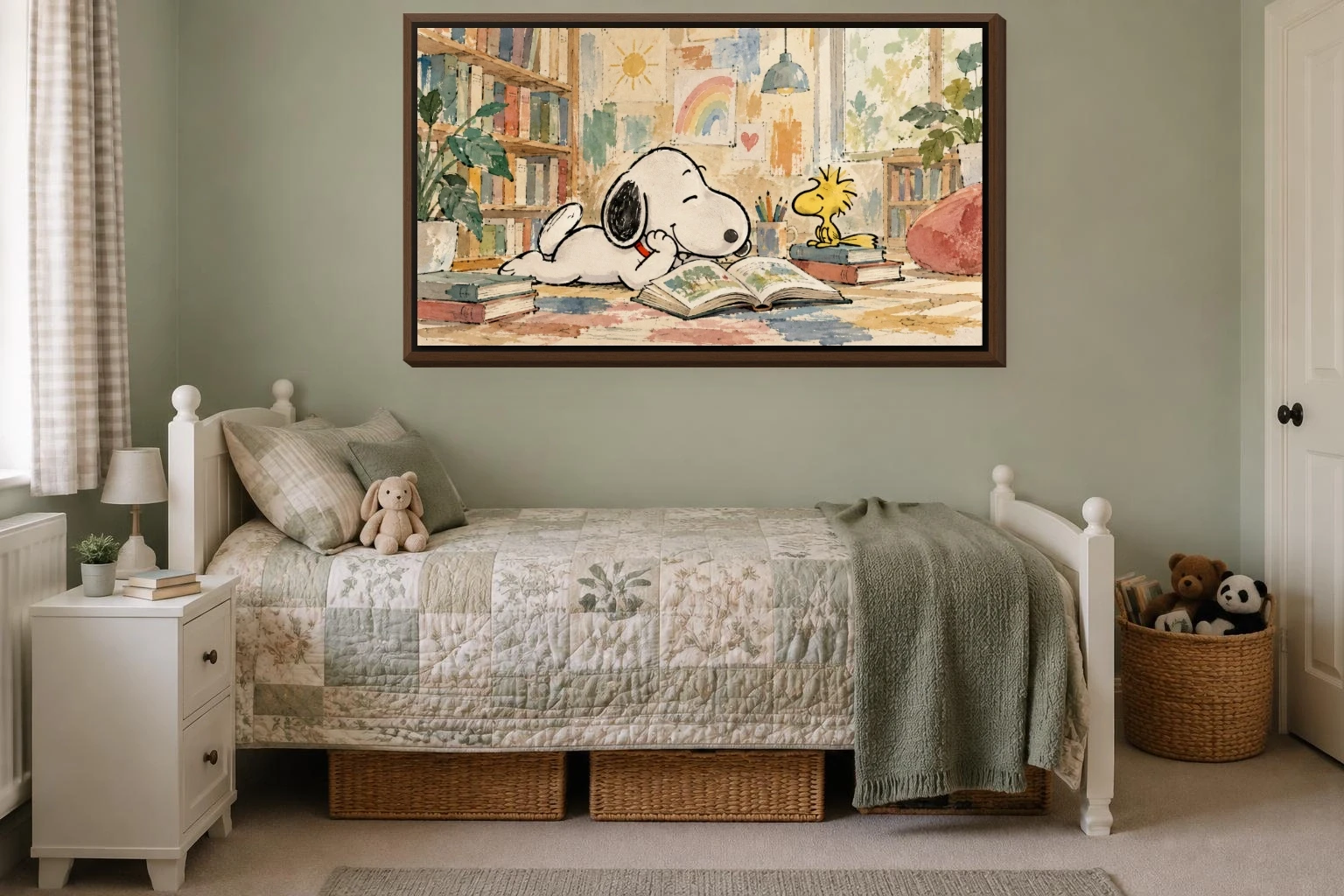
A Story Shared – 30mm Float Effect Canvas is printed onto canvas and depicts Snoopy and Woodstock sharing a quiet reading moment among books and leafy plants. Consider its soft, sun-washed beige and green tones alongside your dining-room colours.
The cover shows the artwork above a white bed against a pale green wall. Use it as a colour reference, not a dining-room placement demonstration. Compare pieces in the Dining Room collection with your chosen centre and measured wall space in mind.
Before committing, inspect the proposed position in daylight and under your usual evening lighting. Look from the doorway and seated positions for distracting shadows, reflections or a pendant obscuring the picture; consider adjusting an existing light’s direction where possible before changing the alignment.
Explore the featured canvas with your preferred centre and both table arrangements in mind.
The featured artwork
A Story Shared Wall Art – 30mm Float Effect Framed Canvas
A premium canvas reproduction of an original painting, handcrafted in a 30mm float-effect frame.
Explore the collections