
Wall Art Guides · 4 min read
Extra Large Canvas Wall Art: A Guide to Scale and Colour
Find the right scale, placement and colour balance for a large canvas, with practical advice for styling a softly coloured abstract.
Published · Updated
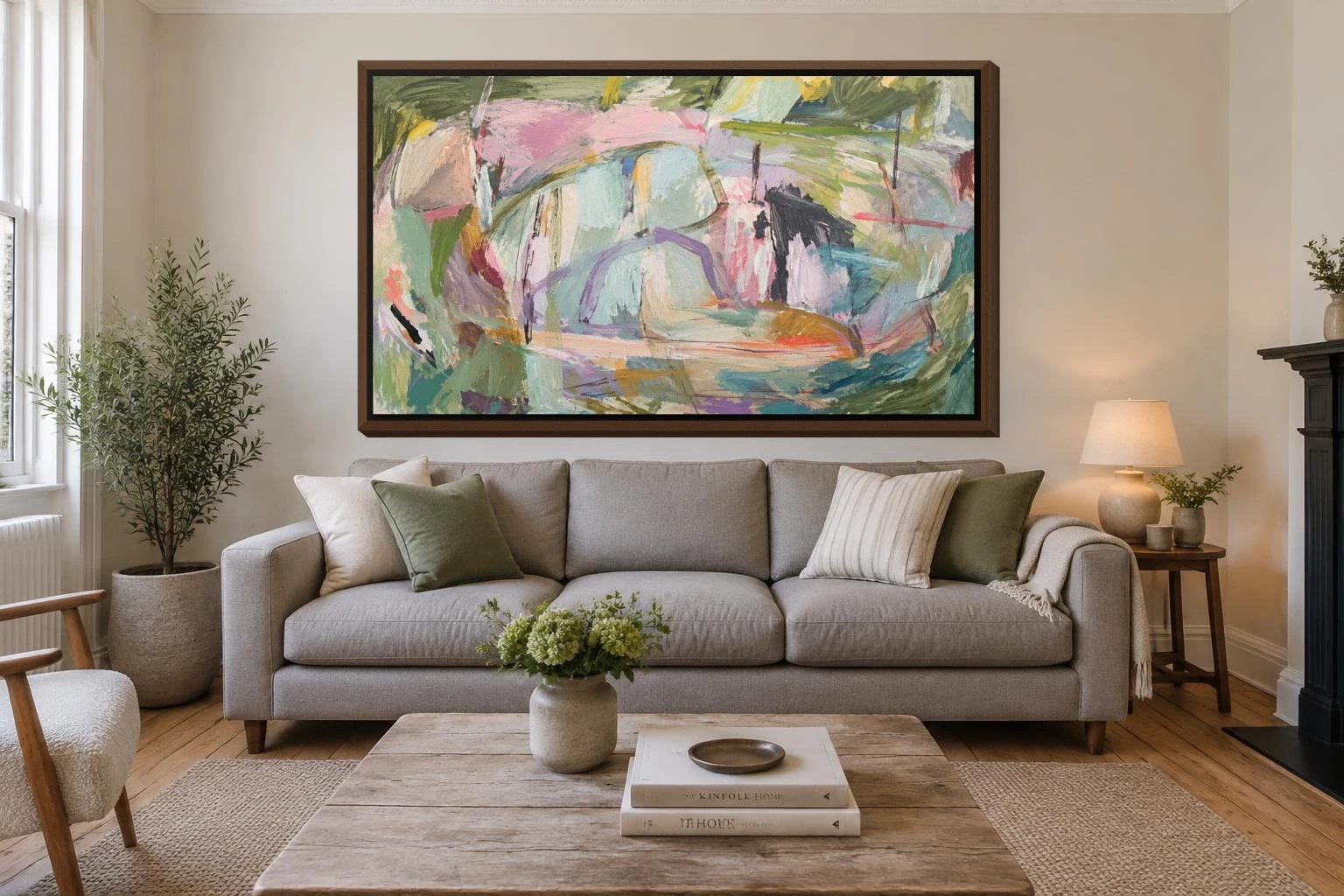
Extra large canvas wall art can give a room a clear focal point without filling every wall. The key is to judge it against your furniture, leave enough space around it and choose colours that connect with the room rather than match everything in it.
Start with the furniture, not the empty wall
Above a sofa or sideboard, use the furniture width as your starting point. An artwork around two-thirds to three-quarters of that width is a useful styling guide, not a fixed rule: a broad, low sofa may suit a wider composition, while nearby shelves or curtains can call for more breathing room.
Measure the clear wall area, including the space between windows, corners and other fittings. Mark your proposed artwork outline with low-tack tape, testing it on an inconspicuous patch first, then look from the doorway and your usual seat. The outline should feel connected to the furniture without crowding its surroundings.
Choose a shape that suits the space
A landscape composition often works well above a long sofa because it follows the same horizontal line. A square format can be more comfortable on a narrower wall or above a compact sideboard. Consider height as carefully as width: a deep canvas needs enough room beneath a cornice or sloping ceiling.
When choosing extra large canvas wall art, check the selected size and its proportions rather than relying on a styled room image. Confirm the measurement units and overall dimensions on the product listing before marking the wall; room photography is best used for styling inspiration, not as a scale drawing.
Use a soft abstract to introduce colour
Pastel Counterpoint – 30mm Float Effect Canvas brings together sweeping curves and expressive brushwork in blush pink, mint and olive, with lilac and charcoal accents. Its softly coloured abstract composition has a lively rhythm, making it a useful starting point for a room that needs colour without a rigid geometric pattern.
Choose one main colour from the artwork to repeat elsewhere, then add a smaller secondary accent. Olive cushions with a muted pink accessory, for example, can create a connection without turning the whole room into a matching set. Keep larger surfaces, such as upholstery and curtains, quieter if you want the brushwork to remain the focus.
For more restrained abstract wall art ideas, work with the charcoal accents rather than introducing every pastel shade. A dark lamp or small decorative object can provide a visual link, while warm neutral walls leave the softer colours room to register.
Hang it in relation to where you sit
Above a sofa, a gap of roughly 15–25 cm between the back of the furniture and the bottom of the artwork is a useful starting point. Adjust for high cushions and anyone leaning back: the canvas should feel part of the seating arrangement, but remain comfortably clear of it.
On an open wall, try placing the centre around standing eye level, then adjust for the room's main viewpoint. For large canvas wall art for living room seating areas, the view from the sofa matters as much as the view from the doorway. Avoid pushing the artwork upwards simply to fill a tall wall.
Before installation, check the artwork's weight, its hanging instructions and your wall construction. Use suitable fixings for the load and surface, check for concealed cables or pipes before drilling, and get help lifting a large piece into position.
Check daylight and evening lighting
Assess the proposed position in daylight and with your usual lamps switched on. Blush and lilac can read differently under warm evening light, while olive and charcoal may feel more prominent in a dim corner. Screen settings also affect colour, so treat on-screen shades as a guide rather than an exact paint-matching reference.
Aim for gentle, even illumination rather than a harsh spotlight. If you use an adjustable light, test its angle so it does not create a distracting bright patch or strong shadow across the artwork. Avoid prolonged direct sunlight as a general precaution when positioning art.
Let one large piece lead the room
A large abstract rarely needs smaller pictures clustered tightly around it. Leave visible wall space at the sides and keep nearby shelves or tabletops relatively simple, especially when the composition already contains expressive marks and several colours.
In a contemporary room, clean furniture lines can balance the movement of the brushwork. In a softer, more traditional setting, plain upholstery and a few rounded accessories can provide the same calm backdrop. Before adding more decoration, live with the arrangement and check whether the room already feels complete.
Explore Pastel Counterpoint or the extra-large and abstract collections with your wall measurements and room palette in mind.
For background on how painters have used canvas as a support, see the Tate glossary entry on canvas.
The featured artwork
Pastel Counterpoint Wall Art – 30mm Float Effect Framed Canvas
A premium canvas reproduction of an original painting, handcrafted in a 30mm float-effect frame.
Explore the collections