Wall Art Guides · 4 min read
Hallway Wall Art for Narrow Corridors: Plan Before You Hang
Find a workable position for hallway art with practical checks for door swings, loaded storage, passing routes and artwork projection.
Published
When choosing hallway wall art for narrow corridors, start with the space you actually use rather than the empty wall alone. Map door swings, load your coat hooks and check passing routes, then test the artwork’s outline and projection before deciding where to hang it.
Map the hallway with doors open and storage loaded
Sketch the doorways, cupboards, switches, radiators and storage. Mark each door’s hinge side, then open it through its normal full swing. Note the reach of both the door and its handle, including cupboard doors. Exclude any candidate position where either could strike the proposed artwork.
Load hooks with the belongings normally left there, including bulky coats and bags. Mark the reach of those items rather than just the hooks. Open shoe storage and reach for everyday belongings so you can assess the wall with the hallway in use.
Walk through carrying your usual bag, and check the route with anyone who regularly uses it. Notice where you turn, pause or pass another person. Treat these as household placement checks, not universal clearance rules; consider leaving a difficult stretch empty.
Test both the outline and the projection
Confirm the proposed artwork’s measurement units and overall dimensions, including any frame, before cutting a paper template. Attach it using a method suitable for your wall finish. Compare two outlines rather than automatically filling the panel between doorways. For broader proportion advice, see How to Choose the Right Size Wall Art.
Ask for the actual installed projection: the distance from the wall to the artwork’s furthest front edge, including its hanging arrangement. Do not infer this from the product name or face dimensions. While the route is clear, hold a ruler perpendicular to the wall to visualise that depth, then remove it before anyone passes.
Ask someone to observe your normal route and consider whether shoulders, bags or hands would enter the proposed artwork’s space. A paper outline alone should not be your final check. Keep the position provisional until you have confirmed the projection; consult Framed Canvas Prints: A Guide to Size, Colour and Placement for wider framing considerations.
Work through three common hallway layouts
Doors on both sides: try one artwork within the clearest wall panel before planning a series. Label the hinges, handle sweeps, loaded storage and proposed artwork projection on your sketch. Check relevant doors both separately and together where they normally stand open. Reject a position that depends on keeping a frequently used door partly closed.
Coat storage opposite the available wall: test with hooks loaded and someone reaching for a bag. Compare the outermost belongings with the proposed artwork’s front edge at the narrowest point. Include cupboard openings and passing traffic. If the route feels awkward, try another wall rather than assuming a higher hanging position will resolve it.
An end wall seen through another room: compare centring the template on the wall with centring it within the doorway view. Look from your usual seated position in the adjoining room and while approaching through the hall. Check nearby hinges, handle sweeps, storage and the turning space beside the proposed projection.
Keep a reusable four-check placement record
Copy this record into a notebook for each option, leaving space after each field: Candidate position. Overall width and height, with units. Confirmed installed projection. Record the dimensions you have verified rather than relying on a size label.
Door swing clear? Record whether every relevant door and handle clears the proposed artwork throughout normal use. Storage clear when loaded? Record whether coats, bags and opening cupboards stay clear, including when someone retrieves an item.
Passing route comfortable? Record any likely contact when walking, turning or carrying everyday belongings. View worth keeping? Compare the entrance, nearby doorways and adjoining-room views. Mark each check as passed, revise or unconfirmed, then note your decision: keep the position, test a smaller outline or move elsewhere.
Choose the composition after finding the position
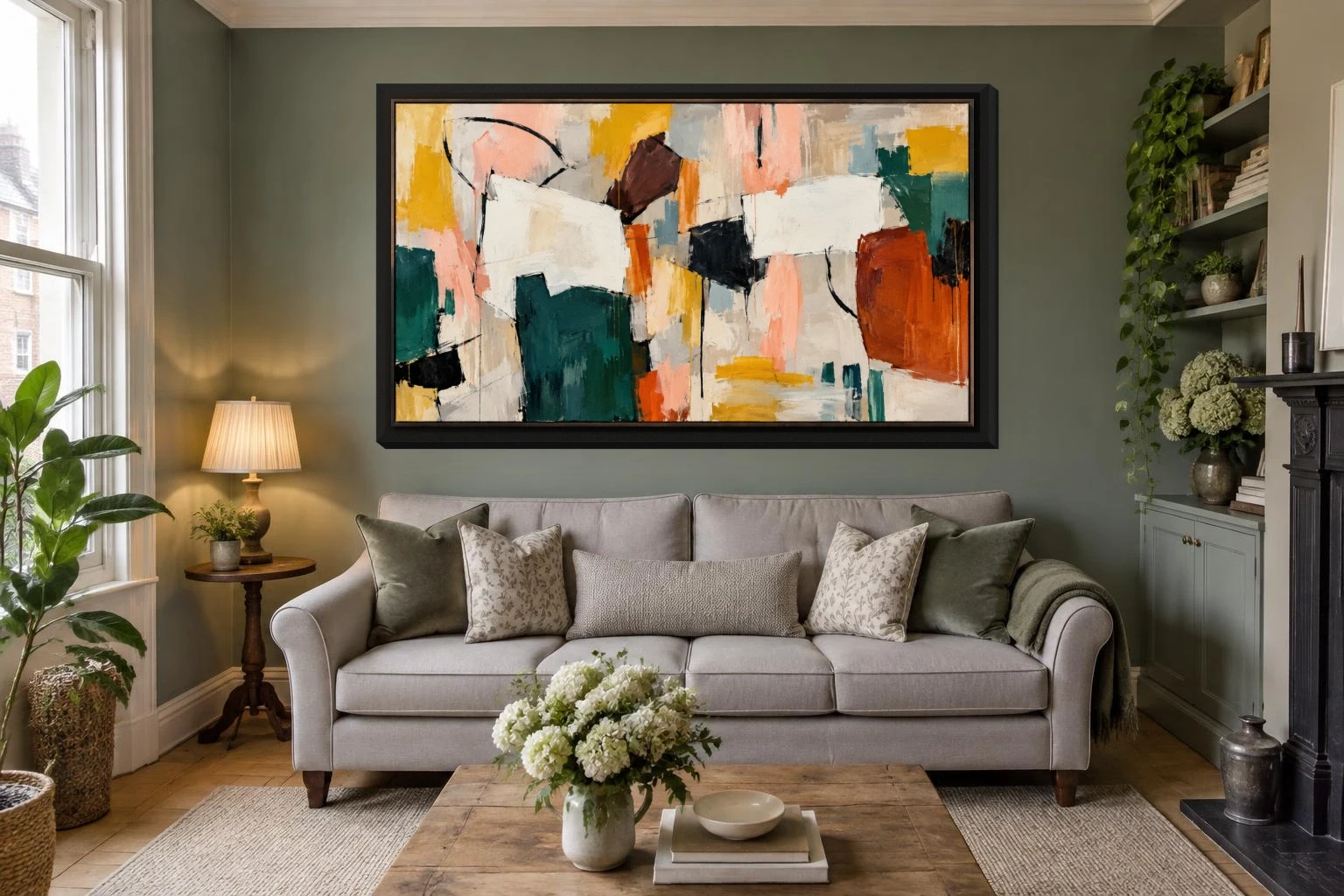
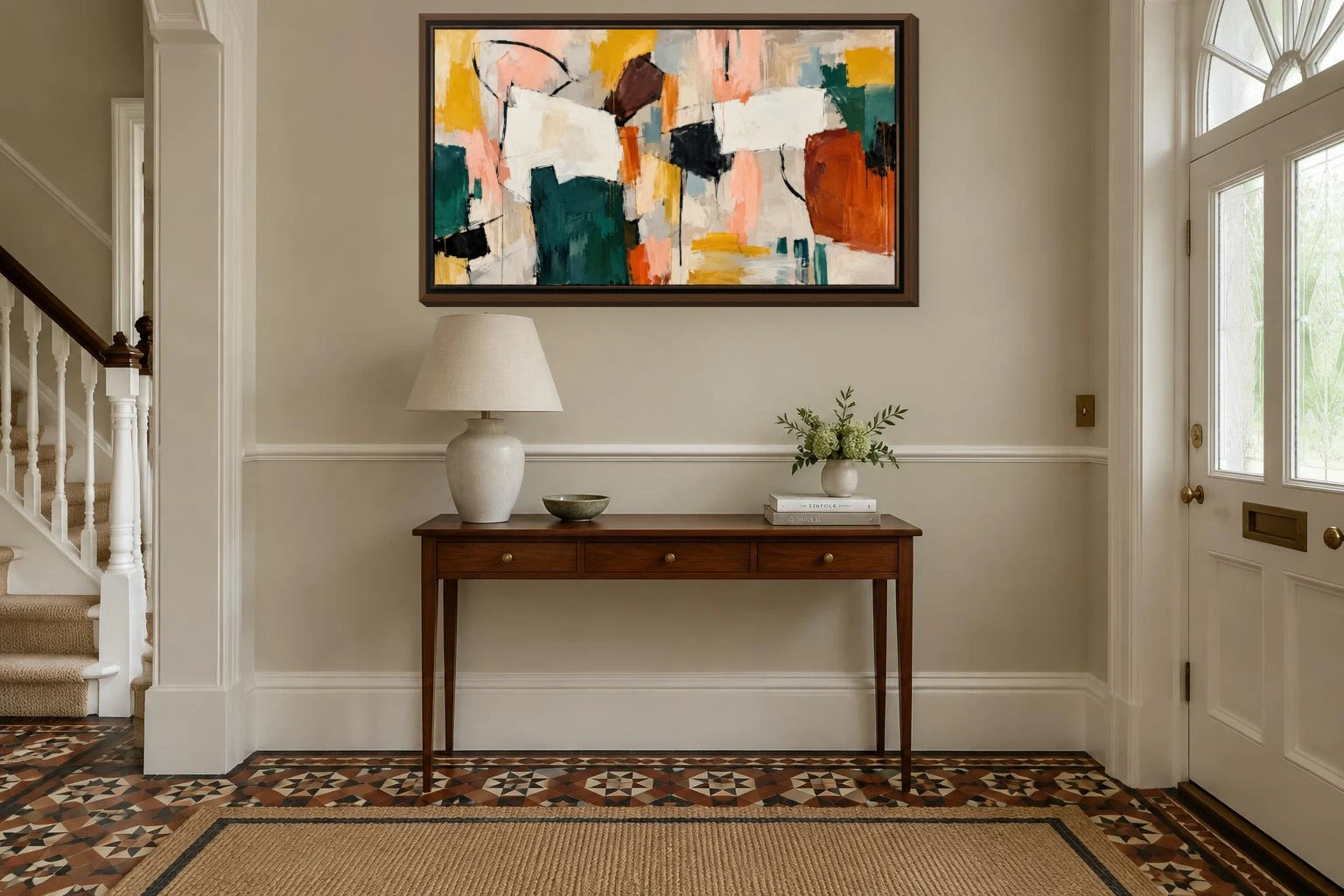
Chromatic Cadence – 30mm Float Effect Canvas combines deep teal, ochre and burnt orange with soft peach and ivory, threaded with sweeping black lines. Its expressive abstract composition is printed onto canvas. Consider repeating one colour in an existing hallway accessory rather than adding several new accents.
The supplied room image shows the artwork above a grey sofa against a muted green wall in a living-room setting, not a tested narrow-hallway installation.
Browse Hallway Wall Art or Small Wall Art against your tested outline and confirmed projection. Review the proposed position in daylight and under your usual evening lighting before settling on the composition.
Repeat the checks before fixing
Leave the template up through a normal day. Use this final trial to repeat the door-swing, loaded-storage, passing-route and viewpoint checks with everyone’s usual belongings in place. If an option only works with coats removed or a door shut, revise it.
Before drilling, confirm the artwork’s weight and choose fixings suitable for that weight and your wall construction. Check for concealed pipes or cables, and seek qualified help if you are unsure about the wall or installation.
Explore Chromatic Cadence or the hallway collection with your tested dimensions and placement record to hand.
The featured artwork
Chromatic Cadence Wall Art – 30mm Float Effect Framed Canvas
A premium canvas reproduction of an original painting, handcrafted in a 30mm float-effect frame.