
Wall Art Guides · 3 min read
Large Abstract Canvas Wall Art: A Guide to Scale and Colour
Find the right scale, position and colour balance for a bold abstract canvas, with practical advice for living rooms and hallways.
Published · Updated
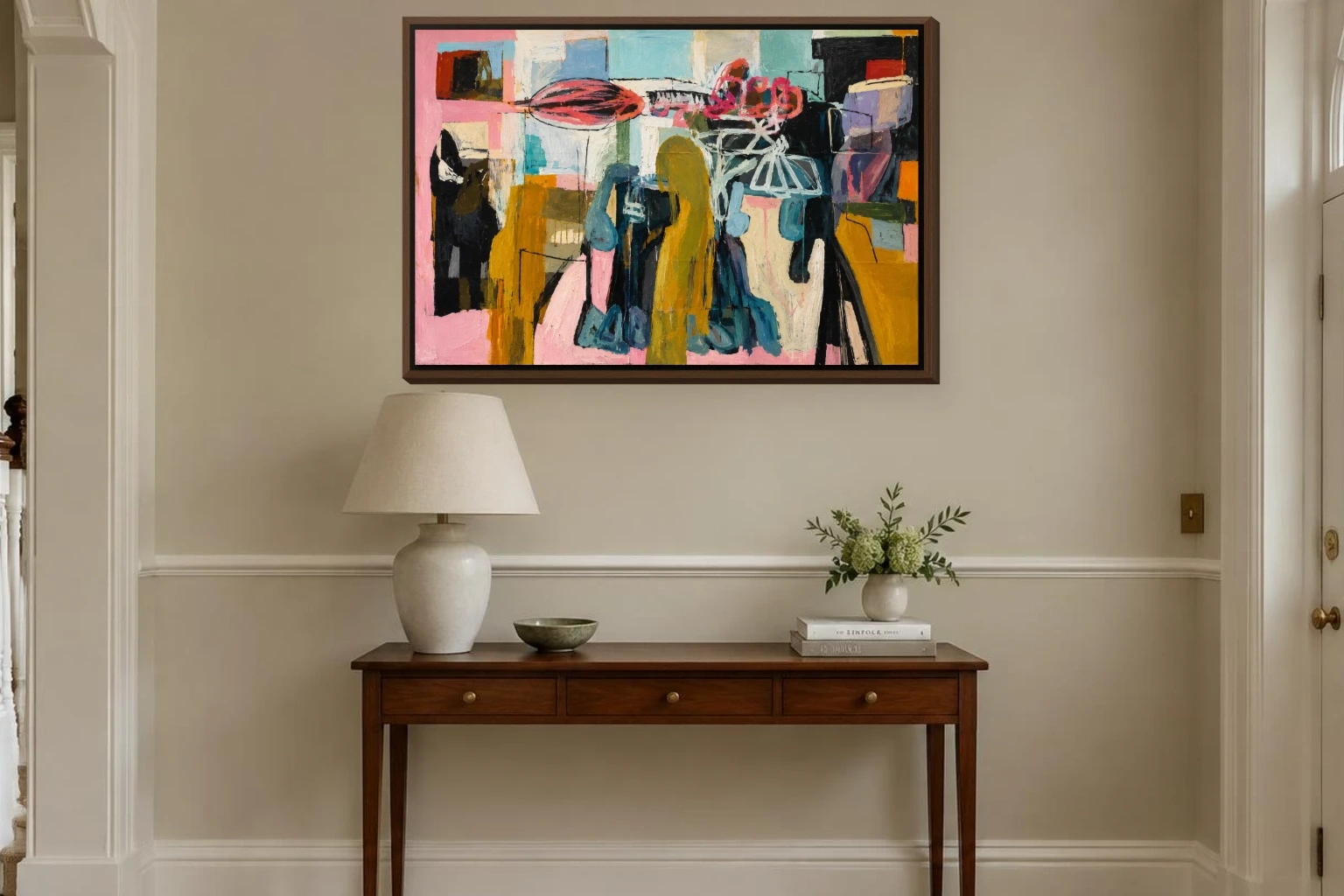
Large abstract canvas wall art can give a room a clear focal point without requiring every furnishing to match. The key is to balance its width with the furniture below, leave enough space around it and carry just a little of its colour into the rest of the room.
Start with the furniture, not the empty wall
Above a sofa, sideboard or console, judge the artwork against the furniture rather than the full width of the wall. As a starting point, try a canvas around two-thirds to three-quarters of the furniture’s width. This usually leaves enough space at either side for the arrangement to feel settled rather than top-heavy.
For example, above a 210 cm sofa, you might test an artwork width of roughly 140–158 cm. These are planning measurements, not product dimensions: mark out the proposed outline with paper or low-tack tape suitable for your wall finish, then view it from the doorway and your usual seat.
Choose a shape that suits the space
A landscape composition often sits comfortably above long furniture, while a square can work well above a compact cabinet or within a more contained wall area. Measure the usable space between doorways, curtains and shelving, not simply the wall from corner to corner.
When choosing large abstract canvas wall art, test height as carefully as width. A broad canvas can still look squeezed if it sits too close to the ceiling or a picture rail. Confirm the selected size and its units on the product page before ordering; do not estimate dimensions from a styled room image.
Let a few colours lead
Ochre Assembly – 30mm Float Effect Canvas brings ochre, rose pink and teal together in an expressive abstract composition. Its bold silhouettes and restless linework give you several possible colour references, but there is no need to repeat them all.
Choose one shade for a modest accent, such as an ochre cushion or a muted teal vase, and let quieter surfaces provide the background. Warm off-white walls and restrained upholstery can make room for the colour; a pink accent can soften the scheme without turning it into a fully coordinated set.
If your room already contains patterned curtains or a busy rug, repeat a colour that is present rather than introducing another. The aim is a connection between the artwork and the room, not an exact match across every accessory.
Set the height from your everyday viewpoint
For a clear wall without furniture below, a centre point around 145–155 cm from the floor is a useful starting point, adjusted to your eye level and the room’s proportions. Above a sofa or sideboard, begin by testing a gap of roughly 15–25 cm between the furniture and the bottom of the artwork.
Treat these as guides rather than fixed rules. Check the arrangement while seated in a living room and while walking through a hallway. Allow clearance for heads above a sofa, and keep tall lamps or branches from obscuring important parts of the composition.
Balance expressive art with quieter surroundings
An expressive abstract does not need an entirely contemporary room. In the featured setting, the colourful composition contrasts with a dark wooden console, pale walls and simple accessories. That contrast gives the artwork prominence without requiring the furniture to echo its shapes.
For a similar balance, keep the surface below relatively uncluttered: a lamp at one end and a small, lower grouping at the other may be enough. In a minimal interior, leave neighbouring walls quiet before deciding whether more artwork is needed. In a layered room, use spacing and restrained accessories to give the canvas room to stand on its own.
Check the light before making the final fixing
Look at the proposed position in daylight and with your evening lamps switched on. Warm lighting can make ochre feel more prominent and alter the balance of cooler teal tones, so judge the palette under the light you actually use.
Avoid prolonged direct sunlight as a general care precaution, and follow the product’s care guidance. If adding directional lighting, aim for an even wash across the composition rather than a bright patch in its centre. Before hanging, check the artwork’s weight, the supplied hanging guidance and the fixings appropriate to your wall type.
Explore Ochre Assembly or the Abstract and Large wall art collections with your room’s measurements and palette in mind.
For background on the style, the Tate glossary on abstract art is a concise introduction.
The featured artwork
Ochre Assembly Wall Art – 30mm Float Effect Framed Canvas
A premium canvas reproduction of an original painting, handcrafted in a 30mm float-effect frame.
Explore the collections