
Wall Art Guides · 4 min read
Staircase Wall Art Placement: Landing or Stairwell?
Compare landing and stairwell positions for one artwork, checking scale, handrail overlap, everyday passage and installation access.
Published
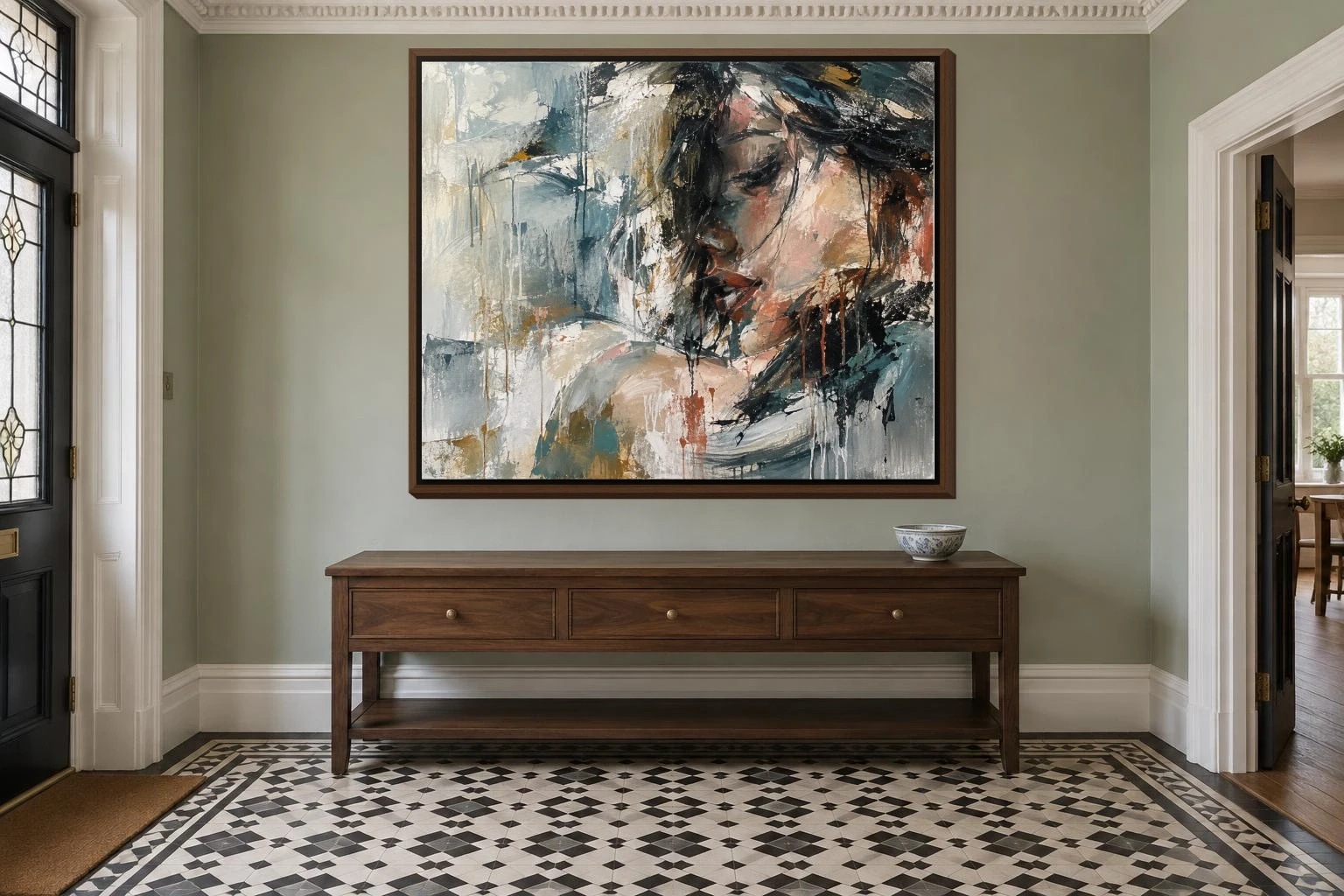
For staircase wall art placement, compare two possible homes for the same piece: the landing wall and the wall beside the stairs. Test both from below and above, then let clear passage and suitable installation access take priority over the more dramatic view.
Start with two positions and two viewpoints
Label your candidate positions Landing A and Stairwell B. Choose the view you most want to enjoy: arriving at the foot of the stairs or approaching the upper landing. Keep both viewpoints in the comparison rather than choosing from one flattering angle.
Take photographs from secure standing positions at the bottom and upper landing, including wall edges, the handrail and door openings. Keep the route clear and do not lean over the rail for a better photograph. When considering wall art on a stair landing, ask whether you could pause to look without blocking a doorway.
Confirm the format and estimate its scale
Confirm your selected format’s full outer width and height, measurement units and installed projection: how far it would extend from the wall. Ask whether the dimensions include any surrounding frame, and confirm the composition for that format. Do not infer these details from a room-setting image.
Use a safely measured reference on the same wall to size a digital outline. Divide the proposed artwork width by the reference’s actual width, then multiply the reference’s width in the photograph by that ratio. Use matching units and preserve the confirmed artwork proportions; repeat for each candidate wall rather than transferring an outline unchanged.
Treat this as an approximate visual comparison, not a fixing template: perspective makes photographic measurements unsuitable for locating fixings. Consider the space beside door frames, beneath the ceiling and around corners. For broader proportion advice, see How to Choose the Right Size Wall Art.
Label the views and mark handrail overlap
Make two pairs of annotated photographs: Landing A — bottom view and Landing A — upper view, then the equivalent views for Stairwell B. Label each outline approximate scale. Mark any point where the handrail appears to cross the proposed artwork, keeping the rail visible rather than covering it with the overlay.
Use the confirmed artwork image if available; otherwise, retain an outline. For a portrait, check whether the rail would cross the face from either viewpoint. Consider a sideways adjustment before raising the whole piece, and try keeping the canvas level rather than following the stair angle.
The cover shows a framed expressive portrait above a wooden console on a pale green wall, not a staircase placement. Use your annotated photographs to judge the two positions; do not stretch or crop the cover into a mock-up.
Separate visual overlap from physical obstruction
Record handrail overlap as a viewing issue, then check physical clearance separately. Using the confirmed installed projection, assess the route beside the canvas, the turn onto the landing and nearby door movement. Consider normal handrail use and carrying everyday items. Reject a position that would require people to dodge the artwork.
Observe both walls in daylight and under your usual evening lighting. Note shadows or concentrated light across the proposed focal point; do not rely on a mock-up to predict them. Consider how the artwork’s colours sit with the paint, flooring and woodwork already visible from each viewpoint.
Apply an installation-access veto
Assess access for measuring, drilling, lifting and securing the canvas before choosing either position. Do not assume a landing offers suitable access simply because its floor is level: consider working space and the nearby stair opening.
Great Britain’s Health and Safety Executive (HSE) guidance advises firm, level ladder support, level stepladder steps, all feet in contact with the ground and no overreaching. Ireland’s Health and Safety Authority (HSA) similarly advises firm, level support or a fitted levelling device and avoiding awkward loads. These are workplace resources, not household-specific hanging rules or artwork-clearance standards.
Do not improvise supports using bricks, blocks or timber. If access involves uneven steps or reaching across the stairwell, reconsider the position or obtain a professional assessment. Ask the installer to confirm the artwork’s weight, wall construction, suitable fixings and checks for concealed pipes or cables.
Copy these three comparison prompts
Shared details: Record the artwork, selected format, confirmed outer dimensions, units and installed projection.
Landing A: Record bottom view, upper view, handrail overlap, passage and door clearance, daylight, evening lighting, and installation access: assessed as suitable or awaiting assessment.
Stairwell B: Record bottom view, upper view, handrail overlap, passage and door clearance, daylight, evening lighting, and installation access: assessed as suitable or awaiting assessment.
Choose landing, stairwell or neither
For your staircase wall art placement decision, exclude positions with obstructed passage or unresolved installation access. If both remain suitable, choose the view and lighting you prefer. Keep three valid outcomes: landing, stairwell, or neither without further help.
As an illustrative example, consider Between Thought and Silence – 30mm Float Effect Canvas, an expressive portrait printed onto canvas in smoky teal, ivory and rose, with sweeping dark strokes and trailing drips. If Landing A keeps the face visible, passage clear and access assessed as suitable, while Stairwell B places the handrail across the face, favour A on those observations—not because landings are automatically safer.
With your preferred position in mind, explore the Hallway collection for a piece to assess against your comparison.
The featured artwork
Between Thought and Silence Wall Art – 30mm Float Effect Framed Canvas
A premium canvas reproduction of an original painting, handcrafted in a 30mm float-effect frame.
Explore the collections