
Wall Art Guides · 4 min read
Wall Art Above Panelling: A Practical Placement Guide
Find a balanced position above a dado rail or within a panel grid, with a copyable measurement record and clear template checks.
Published
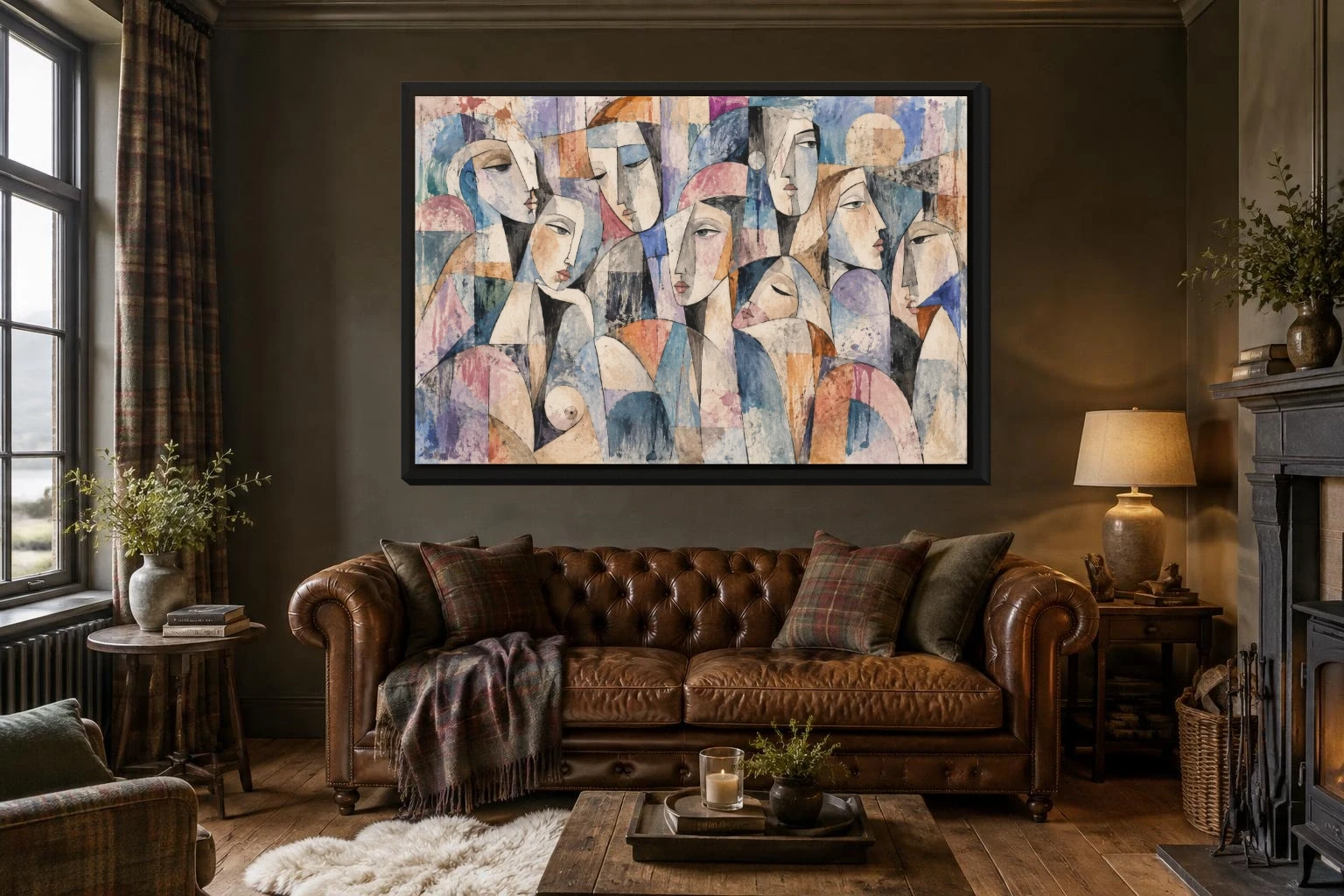
When positioning wall art above panelling, consider the architectural divisions alongside the furniture below before choosing your hanging point. Follow the appropriate route—above half-height panelling or within a full-height grid—and use a paper template to compare the gaps before drilling.
Start with the architectural boundaries
For half-height panelling, use the clear wall above the top rail as your starting display area. Treat the panel divisions below as alignment references, rather than automatic limits on artwork width. For full-height panelling, compare fitting inside one opening with deliberately spanning several divisions.
Consider a footprint that echoes the shape between mouldings, without treating those mouldings as an absolute border. Edward Bulmer’s picture-hanging guidance supports considering these shapes, mocking up arrangements and allowing pictures over panelling. Use the checks below as a visual planning exercise, not a universal spacing rule.
Make one copyable measurement record
Confirm the outer canvas or frame dimensions before cutting a paper template; do not assume the listed artwork size includes its frame. Measure centre positions from the same left-hand reference point. Copy this record for each serious contender, using centimetres throughout.
Trial name: __. Available area, width × height: __. Outer template, width × height: __. Panel centre: __. Furniture centre: __. Usable wall centre: __. Chosen alignment: __. Top clearance: __. Bottom clearance: __. Left clearance: __. Right clearance: __. Clearance boundaries used: __. Furniture or object clearance: __. Mouldings crossed, if any: __.
Half-height panelling: check the rail and upper gap
Measure from the rail top to the ceiling or underside of the cornice. On your paper template, label its centre and bottom edge; on a separate note, identify the rail top, upper boundary and any side limits such as a doorway. Measure the bottom gap from the rail top, not from the panel opening below. Test any temporary attachment method inconspicuously first.
For an illustrative room-planning example, suppose the rail-to-ceiling space is 120 cm and the template is 80 cm high. A 20 cm bottom gap leaves 20 cm above; raising the template by 15 cm leaves 35 cm below and only 5 cm above. If the upper gap feels cramped, consider a shorter template rather than automatically hanging higher. These are hypothetical measurements, not featured-product dimensions.
Compare panel, furniture and wall-centred positions
Panel-centred. Align the template’s centre with the centre of a lower panel. Keep its height unchanged during the three alignment trials, so you can judge horizontal placement separately. Consider this option where the panel rhythm is the feature you most want to emphasise.
Furniture-centred. Move the template to the centre of the sofa, console or sideboard. Check whether this creates an awkward near-touch with a panel division or side boundary. For wall art above panelling behind a sofa, judge the relationship from your usual seat as well as the doorway.
Wall-centred. Align with the centre of the usable display area you measured, rather than automatically using the entire wall. Consider this option when furniture is off-centre or several lower panels share one clear area above. Choose the alignment that leaves the most convincing surrounding space, not simply the neatest measurement.
Full-height grids: fit within or span deliberately
Within one opening. Measure between the inner moulding edges and use those edges as your four clearance boundaries. Start with equal side gaps, then judge top and bottom space independently. Keep neighbouring divisions visible and mark the panel and furniture centres on your template to make their difference easy to assess.
Consider this hypothetical comparison: an 80 cm-wide template centred in a 120 cm-wide opening leaves 20 cm on each side. Moving it 15 cm right to follow the furniture leaves 35 cm on the left and 5 cm on the right. If that narrow gap feels accidental, compare the panel-centred position or a narrower footprint.
Across divisions. Try a footprint that crosses mouldings deliberately rather than almost touching one. Name the crossed divisions in your record and measure clearances to the surrounding boundaries instead. Ask a competent installer to assess support and clearance over raised trim. For broader scale decisions, see How to Choose the Right Size Wall Art.
Use colour to connect art and panelling
A Gathering of Quiet Glances – 30mm Float Effect Canvas is printed onto canvas, with overlapping faces and geometric forms in muted blues, blush pink and ochre. Consider blue or warm neutral paint samples alongside its Cubist-inspired composition and softly weathered colour.
The cover shows the artwork above a brown leather sofa against a dark wall; it does not demonstrate either panelling layout. Use it for colour inspiration rather than spacing guidance. Explore Modern or Framed Art with your preferred outer dimensions in mind.
Check the final position before fixing
Review the preferred template in daylight and evening lighting. Look for distracting shadows beside mouldings or bright patches across the display area. If helpful, photograph the shortlisted positions from the same viewpoint rather than repeating every trial.
Confirm artwork weight and hanging hardware before choosing fixings suitable for the wall and load. Check for concealed pipes or cables, and establish fixing points from the actual hardware rather than the template’s top edge. Do not assume a decorative rail can support artwork; seek installation advice where construction or raised trim makes mounting uncertain.
Explore A Gathering of Quiet Glances or the collections with your preferred alignment and measurements to hand.
The featured artwork
A Gathering of Quiet Glances Wall Art – 30mm Float Effect Framed Canvas
A premium canvas reproduction of an original painting, handcrafted in a 30mm float-effect frame.
Explore the collections
Featured in this story
30% OFFWas From £41.80Now From £29.26
Limited-Time Offer · Save £12.54 · Ends Sat 28 Nov 2026, 00:00