
Wall Art Guides · 4 min read
Wall Art Beside a TV: A Three-Position Test
Compare artwork beside the screen, on an adjacent wall and elsewhere, then choose the position that suits your seated and entrance views.
Published
Unsure whether wall art beside a TV will feel balanced or distracting? Keep the television and sofa fixed, then compare the same artwork beside the screen, on the adjacent wall and elsewhere in the room. Use the comparison to decide where you will enjoy the picture without compromising everyday viewing.
Prepare one template for three positions
Measure the available wall space and confirm your intended canvas’s overall dimensions before making a full-size paper template. Keep its size and orientation unchanged: compare placement before changing proportions. For help choosing that initial footprint, see How to Choose the Right Size Wall Art.
Consult the instructions for your television, bracket and nearby equipment. Allow for specified ventilation, socket access, cables and any movement of an adjustable screen. Treat these requirements separately from the decorative gap between screen and picture.
Label the locations A: beside the screen, B: adjacent wall and C: elsewhere in the room. Use temporary attachment suitable for your wall finish, and leave furniture and lamps in their usual places. Rule out positions that obstruct equipment access before judging their appearance.
A: beside the screen — judge both edges
Try the template on the TV wall. From your main seat, compare a centre roughly level with the screen’s centre against a height related to the furniture below. Rather than automatically matching top edges, look for a relationship that feels comfortable from the sofa.
Check the artwork’s outer edge as carefully as its screen-side edge. Does it squeeze against a doorway, shelving or corner? When placing wall art beside a TV, judge both objects within the available wall space rather than following a universal centimetre gap. If widening one gap crowds the other, move on to B.
B: the adjacent wall — check the corner sightline
Move the same template around the corner. From your usual seat, check whether it still appears immediately beside the screen in your field of view. Look especially at whether the picture and television seem to meet across the corner, despite occupying different walls.
Consider relating the picture to a sideboard or chair on that wall rather than to the TV. Try moving it further along the wall before changing its height. Check from another regularly used seat too: favour B only if the artwork’s position feels worthwhile from the places where people actually sit.
C: elsewhere — give the picture its own setting
Try a position outside the forward TV view, perhaps above a console or behind the sofa. Ask where you would enjoy the picture while entering, reading or talking. Consider accepting reduced visibility from the main seat in exchange for a more satisfying view elsewhere.
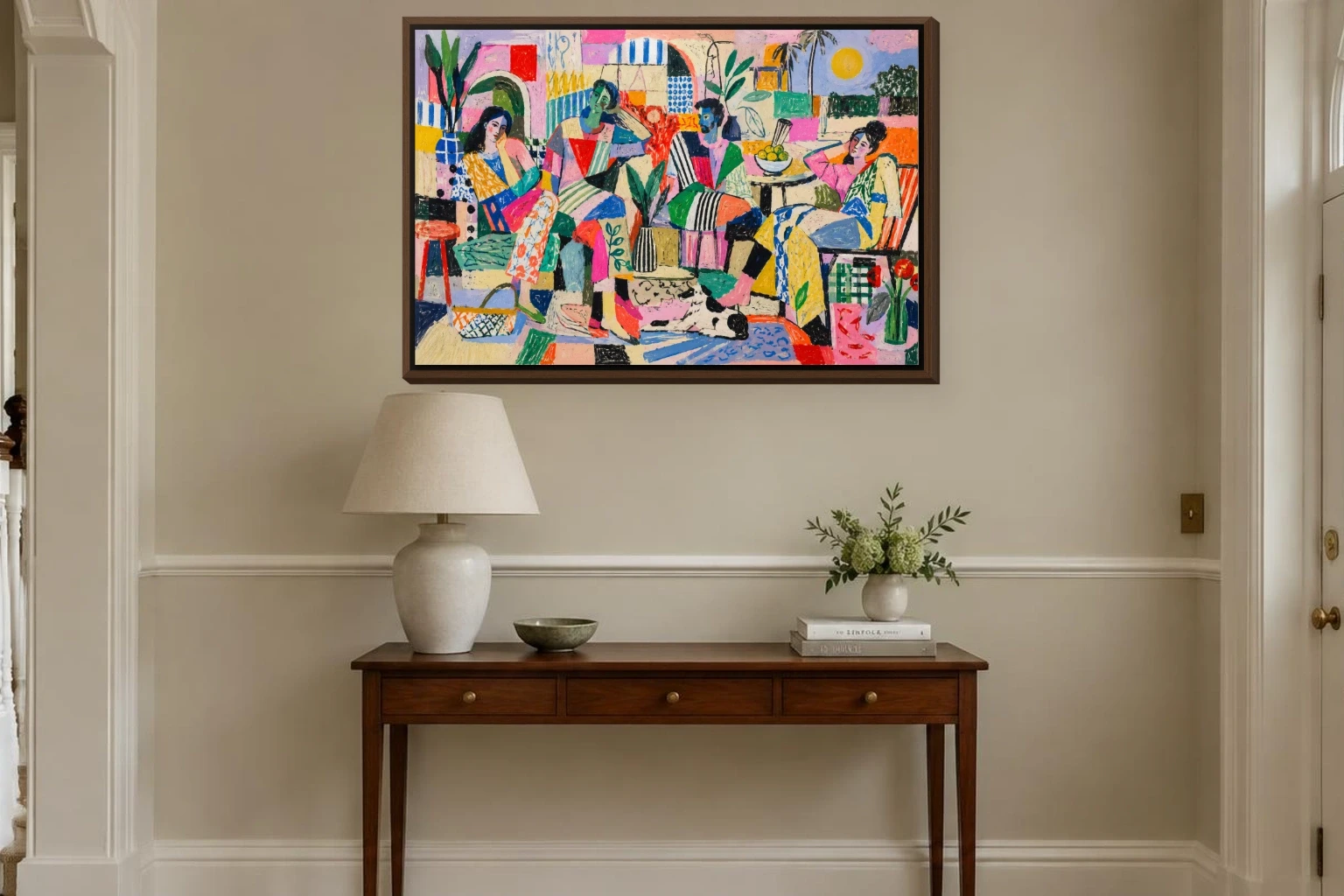
The cover shows colourful figurative artwork above a wooden console, with a lamp, bowl, books and greenery. Use it as inspiration for C, not as evidence of a successful TV arrangement: no television or sofa is visible. Compare your template with the furniture beneath it, adjusting height or alignment if it seems isolated.
Compare the same three views
For each position, record the main-seat view with the TV off, the entrance view and the view during an ordinary programme. Use your usual evening lighting for the TV-on check. If helpful, take photographs from the same marked viewpoints as reminders, but make the decision while seated in the room.
Use the paper template to assess footprint and spacing, not to settle questions about visual distraction. The Sunlit Gathering is an expressive landscape artwork printed onto canvas, depicting four reclining figures in a colourful, plant-filled setting with bold patterns. When considering this or another piece from the Figurative collection, reserve the final judgement about colour and pattern until you can assess the artwork itself.
A hypothetical completed A/B/C record
A — beside the screen. In this hypothetical room, the main-seat view feels cramped at the screen edge; the entrance view looks balanced; the TV-on view feels busy even at the template stage. Decision: reject. The appealing arrival view does not outweigh the crowded seated arrangement.
B — adjacent wall. The main-seat view separates the two rectangles, but the artwork appears narrow at an angle; the entrance view is partly hidden by the doorway; the TV-on view feels comfortable. Decision: reserve. Keep this option if seeing the artwork from the sofa matters most.
C — above a console away from the TV. The main-seat view does not include the picture; the entrance view shows it clearly above the furniture; the TV-on view contains no artwork. Decision: choose. In this example, the reader prioritises enjoying the picture on arrival over seeing it from the sofa.
Resolve the symptom before adding more
Crowded screen edge: reconsider B or C before shrinking the artwork to fill a leftover gap. Distracting artwork: move it outside the seated TV sightline before adding balancing pieces. Isolated-looking picture: adjust its relationship to nearby furniture rather than surrounding it with more art.
Use your preferred position and measured space to narrow the Living Room collection. If none of the positions works, leave the screen wall empty and reconsider the artwork’s size or another room. Before hanging, confirm suitable fixings and concealed cable or pipe locations; seek a competent installer if uncertain.
Explore The Sunlit Gathering – 30mm Float Effect Canvas with your preferred position and measured wall space in mind.
The featured artwork
The Sunlit Gathering Wall Art – 30mm Float Effect Framed Canvas
A premium canvas reproduction of an original painting, handcrafted in a 30mm float-effect frame.
Explore the collections